
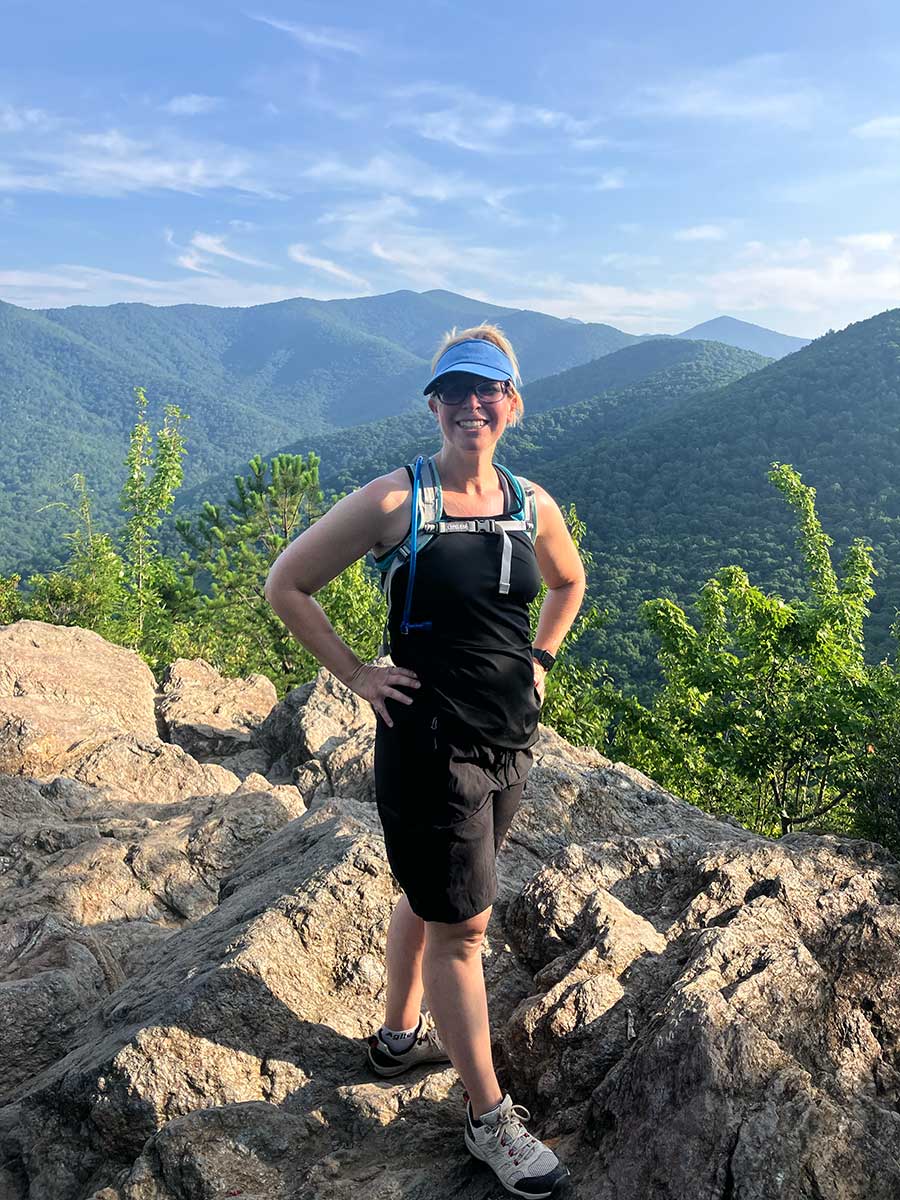
The path curved around a bend and we followed it, ambling along contentedly. We’d been hiking about four hours at that point, in the midst of our July getaway to North Carolina, and were anticipating reaching the end sometime soon. It had been a glorious experience up until then. I’d never hiked a mountain like this- steep peaks, sweeping vistas, such diverse terrain- dark forests and open fields- with elevations climbing steadily higher. We were satisfied with the effort of hard work, our muscles felt satisfyingly sore, we were good and sweaty, feeling inspired by the views, and then… as we turned around the bend- we came to a fork in the road- with no markers to indicate which trail we should take.
Up until this point the trails had been marked clearly. Every juncture we came to aligned with the paths on the map. And then- here we were- suddenly with no clue which way to go. We wandered around in both directions for a bit trying to get our bearings until we came across another hiker with better maps than ours. He informed us we were somewhere way, way, way different than where we imagined ourselves to be. In fact, we’d hiked about 90 minutes in the wrong direction.
We groaned, realizing the enormity of what we’d just heard- we had at least another few hours of hiking ahead of us, we weren’t going to get to the swimming hole we’d planned on, and as if that weren’t enough- we heard thunder rumbling in the distance and realized we might be stuck on a mountain in the middle of a storm. It was an unsettling moment. The stress was rising as we contemplated our options and concluded that regardless of the direction we took- it was going to be a long time until we got a shower.
As we trudged back towards the direction we’d just come from, my husband’s spirits started to flag. I got a second wind, though. “Come on!” I declared like the peppy camp-counselor I was in my youth. “We’ve got enough food and water. We’ll be together and we know how to get back to the last intersection with the map. We can figure out what to do from there!” And with that- we were off. Singing loudly to ward off bears and scrounging up new, interesting conversation topics that we hadn’t already covered. After more than two hours of hiking, we returned to the path where we’d made the wrong turn, we’d climbed down several thousands of feet, and we were back at our car- with darkening skies- but before the rain poured down.
In reflecting on it afterwards, I realized I’d felt such a mix of emotions- happy (prior to getting lost), proud (of the effort of climbing so high), stressed (about whether we’d beat the storm) but never scared or hopeless. When I realized we were lost and our original idea for the day wasn’t going to work out- I was disappointed but also filled with a sense of confidence and purpose. I knew, with certainty, that we would figure the situation out and (whether wet or dry) we’d get off the mountain.
My certainty had nothing to do with my directional ability. (I can get lost anywhere and still need a map in my own neighborhood.) My sense that we would be ok had to do with two core beliefs. “I can handle this,” and “This is figure-out-able.”
When I was in graduate school, I studied the characteristics of hope- what it is and how to generate it. Holding hope can lead to positive life outcomes such as handling stress more effectively and improved adjustment and performance in school and medical settings. Two of the primary components of hope are self-competence (the basic sense that a person is capable) and problem-solving skills (the ability to generate multiple solutions and to keep trying until an effective solution is found).
In the last two decades since I conducted research on hope, I’ve found this to be true again and again in the lives of my clients and my personal life. If a tough situation arises and you tell yourself “there’s nothing to be done” or “It’s out of my control” you may end up feeling hopeless or even depressed. In contrast, if you remember times you’ve successfully handled hard situations in the past and you believe you are someone who can handle hard situations in the future you will feel a sense of capability and determination to figure out a solution. If you believe that problems can be solved by thinking creatively and trying more than one path to get where you want to be- then setbacks don’t paralyze you, they are just part of the process.
Caveat: I’m not suggesting that all situations can be handled simply by shifting your mindset. Facing serious illness, grieving the death of a loved one, and confronting systemic barriers require more than a hopeful outlook. Situations like these require real resources, support, and time that no amount of positive thinking can substitute for. But in many circumstances, how we face the situation is truly the most crucial factor in how we come through it.
So as we go into the final weeks of Summer and the start of Fall, I encourage you to bring a sense of hope with you that whatever you are facing will be ok. Whether you’re a freshman trying to find your classes, a parent figuring out carpools, or a new employee learning the documentation standards of your new work-place- remember: You have successfully done hard things before; this is work-out-able. You’ve got this!